
- 24/7
Customer Service
- IBR Certified
Manufacturer
- Qualified
Expert Professional
Rice Husk Fired Boiler for Rice Mills: Working, Benefits, Applications & Selection Guide
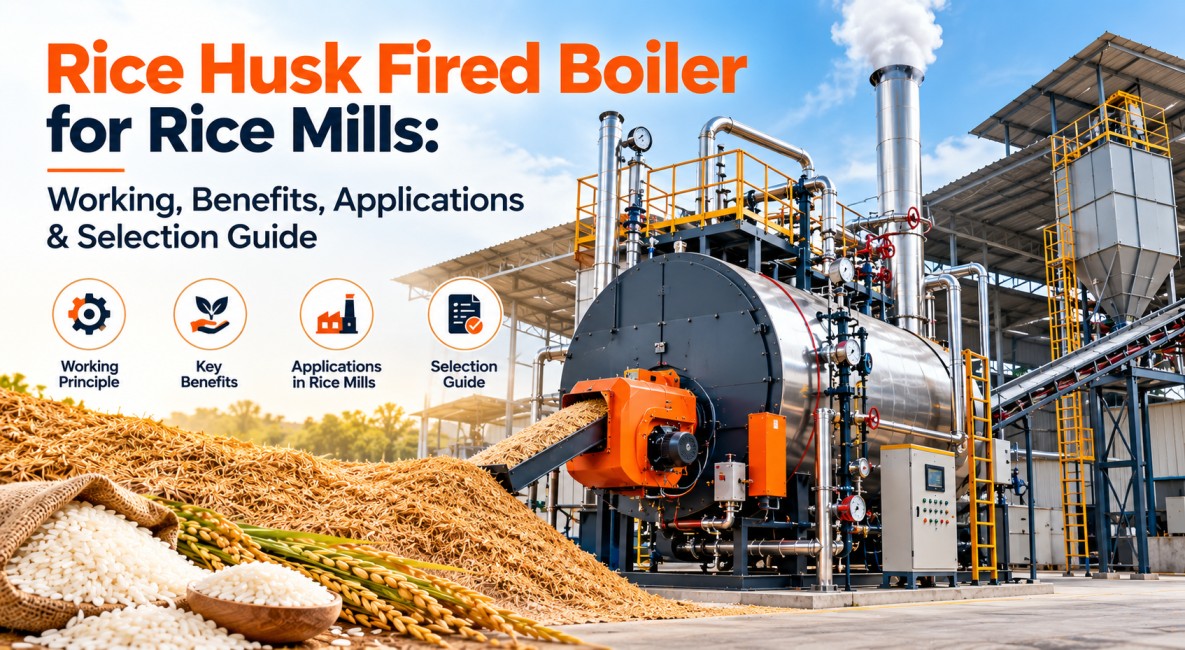
Rice Husk Fired Boiler for Rice Mills: Working, Benefits, Applications & Selection Guide
Rice husking produces large quantities of rice husks as a by-product. Previously, rice husks were considered as agricultural waste products, but modern rice mills are now looking for ways to utilize this product as an energy source. The best way of using rice husks is using rice husk fired boilers.
A well-designed rice husk fired boiler can convert rice husks into energy and steam that may be used in different processes during the processing of rice. This helps rice mills save energy, reduce the use of conventional fuels, and increase the utilization of their by-products.
This guide will look at how a rice husk fired boiler operates and the important factors to consider when buying a boiler for your rice mill.
What Is a Rice Husk Fired Boiler?
A rice husk fired boiler is an industrial boiler designed to use rice husk as a biomass fuel for generating steam or thermal energy.
Rice husk is produced during the milling of paddy. Since rice mills can generate substantial quantities of husk, it can potentially serve as an accessible fuel source for suitable boiler systems.
Unlike conventional boilers designed primarily for fuels such as coal, oil, or gas, a rice husk-fired system requires a combustion arrangement specifically suited to the characteristics of rice husk.
The boiler burns the husk under controlled combustion conditions. The heat generated is transferred to water, producing steam that can then be used for industrial processes.
How Does a Rice Husk Fired Boiler Work?
The basic operation of a rice husk fired boiler involves several stages.
1. Rice Husk Feeding
The rice husk is conveyed from its storage location to the feed mechanism of the boiler. The method of feed depends on the type of boiler and needs of the plant.
Continuous feed is necessary since any changes in the fuel feed would impact the process of combustion.
2. Controlled Combustion
The husk of the rice is put into the combustion chamber or the furnace and burned within it in a controlled manner.
There are certain characteristics of combustion of rice husk which include higher ash percentage and lower bulk density. The furnace and the combustion system have to be designed accordingly.
3. Heat Transfer
The heat produced during combustion is transferred through the boiler heating surfaces to the water contained within the boiler.
As the water absorbs heat, it is converted into steam.
4. Steam Generation
The steam generated is collected and fed to the process equipment of the rice mill.
Based on the layout of the plant, steam may be used for parboiling, heating, drying, or other thermal processes.
5. Flue Gas and Ash Management
Flue gases are passed through heat exchangers and emission control equipment before being released.
Rice husk combustion also results in ashes. Effective ash collection and disposal systems are thus an important component of the entire boiler system.
Why Use Rice Husk as Boiler Fuel?
The major strength of rice husk is that it is produced directly through the process of rice milling.
For a rice mill having enough supply of rice husk, this can give an opportunity to make proper use of the resource.
Rather than transporting or discarding huge amounts of rice husk, a rice mill can make use of the same to produce energy.
This means that there is integration of the process of rice milling and the generation of energy.
Benefits of Rice Husk Fired Boilers for Rice Mills
1. Better Utilisation of Rice Husk
A rice husk fired boiler allows rice mills to put their own biomass residue to productive use.
This can help reduce the quantity of husk requiring external disposal or handling.
2. Potential Reduction in Fuel Costs
Rice husks may function as biomass fuel that could replace traditional fuels based on the cost of fuels in the locality, supply of rice husks, the efficiency of the boiler, and operating conditions.
Where a mill produces enough rice husks, an adequate biomass boiler will enable it to minimize reliance on purchased fossil fuels.
3. Supports Energy-Efficient Operations
A well-designed boiler is capable of transforming biomass fuel into energy in the form of steam by efficiently transferring heat and controlling the combustion process.
Increased efficiency of the boiler may aid in reducing fuel requirements.
4. Suitable for Rice Processing Applications
Steam produced from a rice husk boiler may be applied to many processes within rice processing plants, especially those requiring thermal energy to be applied under control.
The process is especially applicable in integrated rice mills and parboilers.
5. Better Waste Management
Rice husk can be difficult to handle and transport because of its low bulk density.
Using it as boiler fuel can provide rice mills with a productive route for managing this by-product.
6. Supports Biomass Energy Utilisation
The rice husk is a renewable biomass waste material. With proper biomass combustion technology, it may help in achieving more efficient methods of generating energy for industries.
Nonetheless, performance in terms of environment will depend on how the combustion process, boilers, emission control systems, and other relevant regulations are followed.
Applications of Rice Husk Fired Boilers in Rice Mills
A rice husk-fired boiler can support various thermal applications depending on the plant's configuration.
Rice Parboiling
One of the uses is parboiling of rice.
Parboiling consists of soaking, heating or steaming, and drying of paddy before milling. The steam produced from the boiler can be used to supply the heat needed for proper parboiling process.
Steam supply is essential to ensure stable processing environment.
Paddy Steaming
Steam can also be used for steaming operations associated with rice processing.
Rice Drying
Thermal energy generated from the boiler can support drying systems where hot air or steam-based heating is required.
Process Heating
Some integrated rice mills may use steam or thermal energy for other process-heating requirements.
Combined Industrial Applications
For larger plants, the boiler could be a component of an entire biomass energy system used in different thermal processes in the plant.
How to Select the Right Rice Husk Fired Boiler
Selecting a boiler should be based on the actual requirements of the rice mill rather than simply choosing the highest-capacity model.
1. Determine Steam Requirement
Start by calculating the plant's total steam demand.
Consider:
• Daily rice processing capacity
• Parboiling capacity
• Number of operating hours
• Peak steam demand
• Required steam pressure
• Future expansion plans
A proper steam-load assessment helps prevent both under-sizing and unnecessary over-sizing.
2. Evaluate Rice Husk Availability
Determine how much rice husk your mill generates and how consistently it is available.
Important factors include:
• Quantity of husk generated
• Moisture content
• Storage capacity
• Seasonal availability
• Fuel feeding requirements
• Ash characteristics
The boiler should be designed around the actual fuel characteristics.
3. Consider Boiler Efficiency
Fuel consumption has a direct impact on operating expenses.
Compare manufacturers based on technical parameters such as:
• Thermal efficiency
• Fuel consumption
• Heat losses
• Steam generation
• Operating pressure
• Combustion efficiency
A boiler with good efficiency can provide better long-term economics.
4. Check Automation and Control Systems
A modern industrial boiler system may use automation for fuel feeding, combustion, water level, pressure regulation, alarms, and safety interlocks.
The degree of automation necessary varies according to the plant size, requirements, and budget.
5. Evaluate Ash and Emission Management
There is production of ash from burning rice husks, thus making it a significant process to take into consideration.
It is imperative that the boiler system incorporates appropriate pollution control equipment taking into account the kind of fuel, type of boiler, among others.
6. Consider Maintenance and Service Support
Rice mill boilers are investments for the long term. Issues regarding spare parts, technical assistance, maintenance and training need to be evaluated before buying. An experienced industrial boiler manufacturer can be helpful in this regard.
Rice Husk Boiler vs Conventional Fuel Boiler
The right fuel depends on the specific operating conditions of the rice mill.
A rice husk boiler can be particularly attractive when a mill has reliable access to sufficient quantities of husk. Conventional fuel boilers may be more appropriate where biomass availability is limited or where specific process requirements demand another fuel source.
Therefore, the decision should consider:
• Fuel availability
• Fuel cost
• Steam demand
• Boiler efficiency
• Storage requirements
• Environmental requirements
• Maintenance
• Total cost of ownership
Rather than comparing only the initial equipment price, rice mill owners should evaluate the overall economics of the boiler throughout its operating life.
Why Boiler Design Matters
However, not all types of biomass boilers are suitable for the burning of rice husk.
In this case, one must bear in mind that rice husk possesses certain combustion characteristics. Particularly, a fairly large amount of ash and the low bulk density may lead to problems with fuel supply, combustion process, ash removal, and heat-exchange surfaces.
Therefore, it is advisable to design a boiler that will be able to work with this type of fuel.
Maintenance Tips for Rice Husk Fired Boilers
Regular maintenance is essential for maintaining boiler efficiency and reliability.
Rice mills should establish preventive maintenance schedules covering:
• Furnace and combustion system inspection
• Boiler tube inspection
• Ash removal
• Fuel feeding equipment
• Fans and blowers
• Safety valves
• Water-level controls
• Pressure gauges
• Emission-control equipment
• Insulation and refractory condition
Regular cleaning and inspection can help reduce heat-transfer losses and identify potential problems before they result in unexpected downtime.
Frequently Asked Questions
What is a rice husk fired boiler?
A rice husk fired boiler is an industrial boiler designed to burn rice husk biomass and convert the resulting heat into steam or useful thermal energy.
Can rice husk be used as boiler fuel?
Yes. Rice husk can be used as biomass fuel in suitably designed combustion and boiler systems. The boiler should be engineered according to the husk's characteristics and the plant's operating requirements.
What is the main application of a rice husk boiler in a rice mill?
A major application is generating steam for rice parboiling. Depending on the plant, the steam can also support drying, heating, steaming, and other thermal processes.
How do I select the right rice husk boiler capacity?
Boiler capacity should be selected after evaluating steam demand, rice processing capacity, operating hours, peak load, required steam pressure, fuel availability, and future expansion requirements.
Is a rice husk boiler suitable for every rice mill?
Suitability depends on factors such as rice husk availability, steam requirements, plant configuration, fuel characteristics, space, environmental requirements, and economics. A technical assessment is recommended before selecting the system.
Conclusion
A rice husk fired boiler for rice mills can provide an effective way to convert a readily available rice-milling by-product into useful thermal energy. With the right design, it can support rice parboiling, drying, steaming, and other industrial applications while helping mills improve resource utilisation and potentially reduce dependence on conventional fuels.
However, selecting the right boiler requires careful consideration of steam demand, rice husk characteristics, boiler efficiency, combustion technology, automation, ash handling, emission control, safety, maintenance, and after-sales support.
For rice mill owners planning a new boiler installation or upgrading an existing system, working with an experienced industrial boiler manufacturer is essential.
Himani Boiler offers industrial boiler solutions designed for demanding industrial applications. If you are looking for a rice husk fired boiler for your rice mill, contact Himani Boiler to discuss your fuel characteristics, steam requirements, plant capacity, and application-specific requirements.