
- 24/7
Customer Service
- IBR Certified
Manufacturer
- Qualified
Expert Professional
ESP vs Bag Filters — What Actually Makes Sense for Your Plant?
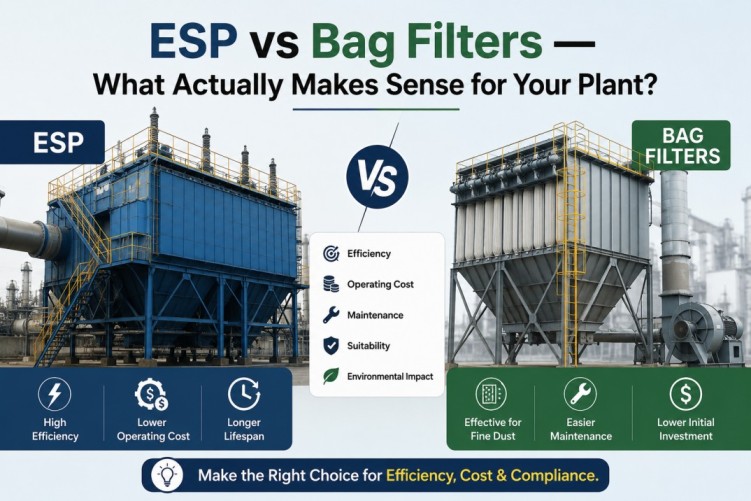
ESP vs Bag Filters — What Actually Makes Sense for Your Plant?
If you're running a facility in Delhi or the NCR region, you already know the pollution control norms have gotten serious. CPCB isn't playing around anymore, and whether you run a boiler house, a cement plant, or a steel unit, getting your particulate emissions in check is just part of doing business now.
So the big question most plant managers end up asking is, ESP or bag filter? Both work. Both are widely installed across the Indian industry. But pick the wrong one for your setup, and you're looking at compliance headaches, higher running costs, and maintenance teams pulling their hair out.
Let me break it down practically.
How Does Each System Actually Work?
An ESP, electrostatic precipitator, charges dust particles using high-voltage electrodes as flue gas passes through. Those charged particles get pulled onto collection plates, and periodically the plates get rapped so the dust falls into hoppers. Simple enough in principle, and these things have been running in thermal power plants for decades.
A bag filter does something far more straightforward: it pushes dirty gas through fabric bags, traps the dust on the surface, and periodically blasts it off with compressed air. No high voltage, no electrodes, just filtration.
Where Each One Wins?
ESPs shine when you're dealing with massive gas volumes and high temperatures, think coal-fired boilers or cement kilns, where gas temperatures can hit 400°C. They also have very low pressure drop, which matters when you're moving enormous volumes of gas and don't want to burn extra fan power.
Bag filters, on the other hand, are simply more reliable at hitting tight emission numbers. We're talking 99 to 99.9% filtration efficiency, consistently, and pulse-jet systems can get you below 5 mg/Nm³, which is exactly where the newer CPCB norms are pushing everyone.
The catch with ESPs is that their efficiency is tied to dust resistivity. Change your coal quality, moisture content, or sulfur levels, and ESP performance can dip without warning. Bag filters don't care about any of that; they physically trap particles regardless of what's happening upstream.
Running Costs — The Real Picture
ESPs cost more upfront but are cheaper to run over time. No bags to replace, lower energy consumption, and maintenance intervals are longer.
Bag filters are cheaper to install, but the ongoing costs add up; bags need replacing every two to five years, compressed air consumption is real money, and the higher pressure drop means bigger fan power bills.
If your process conditions are stable and your gas volumes are huge, ESP economics usually work in your favour over a long horizon. If your process is variable or you need guaranteed compliance, bag filters give you more predictable results.
The Safety Angle Nobody Talks About Enough
ESPs generate sparks. If you're handling combustible dust, coal dust, wood dust, or metal powder, that's a genuine fire and explosion risk that needs to be engineered around carefully.
Bag filters don't have that problem. You still need explosion protection in some applications, but the base risk is lower.
What's Happening in Delhi-NCR Right Now
A lot of older plants that were running ESPs are now either upgrading them or switching to bag filters entirely. The tightening of CPCB limits, many industries to stay below 50 mg/Nm³, and new plants sometimes need 30 mg/Nm³ or lower, has pushed bag filters to the front of the queue for reliable compliance.
That said, ESPs aren't going anywhere. For large power plants and cement kilns, they're still the practical choice.
ESP vs Bag Filter: Direct Comparison
|
Parameter |
ESP |
Bag Filter |
|
Working Principle |
Electric field charges particles, collected on plates |
Mechanical filtration through fabric bags |
|
Filtration Efficiency |
95–99% |
99–99.9% |
|
Operating Temperature |
Up to 400°C |
Up to 260°C |
|
Pressure Drop |
300–500 Pa |
1,500–2,500 Pa |
|
Capital Cost |
Higher |
Moderate |
|
Maintenance Cost |
Lower |
Higher |
|
Sensitivity to Process Changes |
High |
Low |
|
Best For |
Power plants, cement, and metal plants |
Steel, pharma, chemical, and food industries |
Go with an ESP if your gas temperatures are very high, your process is stable, and you're moving huge volumes.
Go with a bag filter if your emission targets are tight, your process conditions vary, or you're dealing with fine particles and need consistent compliance.
And if you want the best of both, some facilities run a hybrid — ESP first to knock out the bulk of the dust, bag filter second to clean up the fines. More complex to engineer, but it works well in the right application.
Bottom line
Get a proper engineering assessment done before you commit. The right answer depends on your specific gas volume, temperature, dust type, and what the regulators are expecting from your category of plant.