
- 24/7
Customer Service
- IBR Certified
Manufacturer
- Qualified
Expert Professional
How to Select the Best Industrial Boiler for a Modern Rice Mill
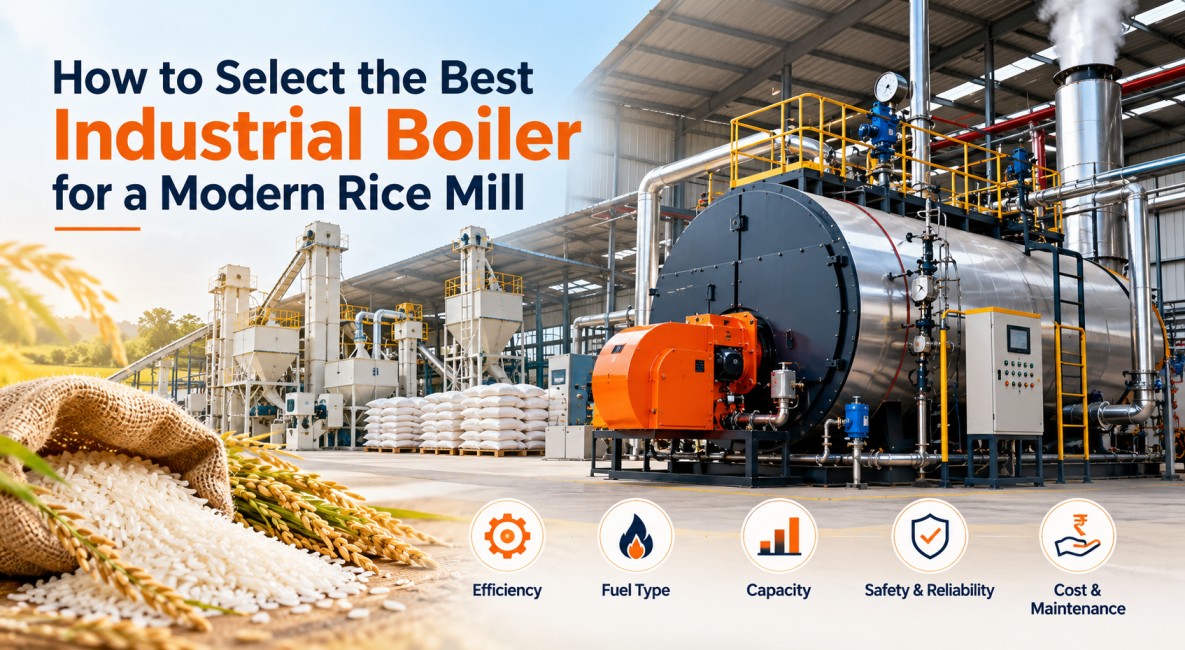
How to Select the Best Industrial Boiler for a Modern Rice Mill
The rice milling industry is becoming increasingly focused on energy efficiency, production reliability, operational cost reduction, and sustainable manufacturing. In modern rice mills, boilers play a critical role in generating the steam and thermal energy required for processes such as rice parboiling, drying, heating, and other production applications.
Selection of the most appropriate boiler system becomes a crucial choice for a modern rice mill. The appropriate boiler will not only enhance the production efficiency but also save fuel and reduce plant downtime. But selection of inappropriate boiler can have adverse effects on plant's operating expenses and productivity.
But how to choose the most appropriate boiler for a modern rice mill?
1. Understand Your Rice Mill's Steam Requirement
The first step in selecting an industrial boiler is understanding your plant's actual steam requirement.
A rice mill may require steam for.
• Rice parboiling
• Paddy steaming
• Rice drying
• Heating applications
• Hot water generation
• Process heating
• Other auxiliary operations
The amount of steam needed is based on considerations like the total amount of rice to be processed per day, number of parboiling machines, operation hours, steam pressure, and production process.
Using a boiler that has insufficient capacity leads to insufficient steam supply and delays in production. But using an overly large boiler leads to unneeded capital expenditure and inefficiency in the use of fuel.
Hence, perform steam load assessment before determining the boiler capacity.
2. Consider Rice Husk as a Fuel Source
One of the primary advantages that rice mills have access to is the presence of rice husk, which is a byproduct of the rice milling process.
Rather than treating rice husk as a waste product in the agricultural process, rice mills today have the option of burning it as a biomass to feed appropriate boilers. A well-designed boiler burning rice husk can help to transform this byproduct into valuable thermal energy.
Some of the advantages of burning rice husk as a fuel include:
• Efficient use of rice mill byproducts
• Less reliance on traditional fuels
• Reduction in fuel costs, potentially
• Good waste disposal practice
• Plant sustainability
However, there are some particular qualities that need to be kept in mind about the combustion of rice husk. These include the amount of ash, moisture content, density, and other factors.
3. Select the Right Boiler Type
Various industrial boiler designs are applicable to various operational needs. Some common industrial boiler designs include fire tube boilers, water tube boilers, biomass boilers, and specialized steam generation systems.
In the case of an advanced rice mill, the selection should consider the following:
• Steam capacity needed
• Pressure requirement
• Fuel source
• Nature of the fuel
• Space available
• Efficiency desired
• Operational demands
• Maintenance consideration
In the case of large-scale industries requiring higher steam capacities and pressures, water tube boilers could be suitable. For some low-capacity industrial applications, different types of boilers can prove to be suitable.
The most significant thing to realize here is that there is no such thing as a universally best boiler. The best industrial boiler for your rice mill will be the one that matches your requirements.
4. Focus on Boiler Efficiency
The efficiency of the boiler is a determining factor for the operating cost of a rice mill.
A boiler that uses too much fuel in order to produce the desired amount of steam is sure to raise the cost of production in the long run. Thus, when purchasing boilers, it is important to consider their efficiency in terms of thermal efficiency and energy efficiency in general and not just the price.
An efficient boiler may lead to:
• Less fuel consumption
• Lower costs
• Better steam production
• Lower heat losses
• More efficient operation in general
While comparing boilers offered by different manufacturers, you should ask for technical data on these parameters.
5. Evaluate Steam Pressure and Temperature Requirements
Different rice processing applications may require different steam conditions.
Before selecting a boiler, determine the required:
• Steam pressure
• Steam temperature
• Steam flow rate
• Operating hours
• Peak steam demand
The boiler should be capable of maintaining stable steam conditions during both normal and peak production periods.
Inconsistent steam pressure can affect processes such as parboiling and may result in variations in production quality. Therefore, stable steam generation should be a key consideration when selecting an industrial boiler for a rice processing plant.
6. Look for Reliable Automation and Controls
Modern rice mills make use of automation to increase efficiency and minimize human intervention.
There is an industrial boiler that comes with suitable control and monitoring system, which will assist in monitoring the following variables:
• Pressure of steam
• Temperature
• Water level
• Fuel feed
• Combustion
• Boiler performance
Automation can increase efficiency and safety in addition to maintaining constant conditions.
Depending on the capacity of the plant, there could be automatic fuel feed, automatic control system, alarms, interlocks, and monitoring systems, which can make the operation of the boiler convenient.
7. Consider Emission and Environmental Requirements
It is essential that environmental performance becomes increasingly important for modern industries.
When choosing a boiler for a rice mill, one should think of adequate combustion and emission control systems in order to ensure proper fuel combustion and meet the necessary environmental standards.
According to the type of boiler and fuel used, one might use cyclone dust collectors, bag filters, scrubbers and other pollution control systems.
Proper combustion not only reduces emissions, but can also increase fuel efficiency.
8. Don't Ignore Maintenance and After-Sales Support
A boiler is a long-term industrial investment. Selecting the equipment is only the beginning; proper maintenance and technical support are equally important.
Before purchasing a boiler, consider:
• Availability of spare parts
• Ease of maintenance
• Service support
• Installation assistance
• Operator training
• Inspection and servicing requirements
• Manufacturer's technical expertise
A manufacturer with strong after-sales support can help reduce unexpected downtime and keep the boiler operating efficiently throughout its service life.
9. Check Safety Features
No compromises should be made when choosing an industrial boiler from the perspective of safety.
The boiler should have safety devices and systems that protect the boiler in terms of parameters such as pressure, water level, temperature, and combustion.
Some important safety devices could include pressure relief systems, safety valves, water level control devices, alarms, interlocks, and others, depending on the design of the boiler.
10. Compare Total Cost of Ownership
The cheapest boiler is not necessarily the most economical boiler.
When comparing different industrial boilers, consider the total cost of ownership, including:
• Initial equipment cost
• Installation cost
• Fuel consumption
• Maintenance expenses
• Spare parts
• Labour requirements
• Downtime costs
• Expected operating life
A highly efficient boiler may have a higher initial investment but deliver greater savings over its operating life.
Therefore, rice mill owners should evaluate long-term operational economics rather than selecting equipment solely on purchase price.
Why the Right Boiler Matters for a Modern Rice Mill
A well-designed boiler system can become an important part of a rice mill's overall energy strategy. It can provide reliable steam for processing, utilise available biomass fuel, improve energy efficiency, and support consistent production.
For rice mills generating significant quantities of rice husk, a properly engineered rice husk-fired boiler system can be particularly valuable when designed according to the plant's fuel characteristics and steam requirements.
However, the correct selection depends on several factors, including plant capacity, steam demand, fuel availability, pressure requirements, operating conditions, environmental requirements, and budget.
Conclusion
In selecting the most appropriate industrial boiler for today's modern rice mill, the process goes beyond the mere comparison of boilers’ prices or capacities. Owners of rice mills must consider several factors including the demand for steam, fuel, efficiency of boilers, operating pressure, automation, safety, emissions, maintenance, and operational costs.
By choosing the right boiler design, you can benefit from increased energy efficiency, reduced fuel usage, improved reliability, and better utilization of rice husks produced in the milling process.
If you plan to construct a rice mill, replace an old boiler or install a rice husk fired industrial boiler, collaboration with an experienced boiler manufacturer will help to choose the right solution for your specific needs.
Himani Boiler is a company that designs and manufactures industrial boilers for various industrial applications. Our representatives are ready to help you to analyze the steam demands of your rice mill and find the best boiler for your plant.