
- 24/7
Customer Service
- IBR Certified
Manufacturer
- Qualified
Expert Professional
Energy-Efficient Boilers for Food Processing Plants in India
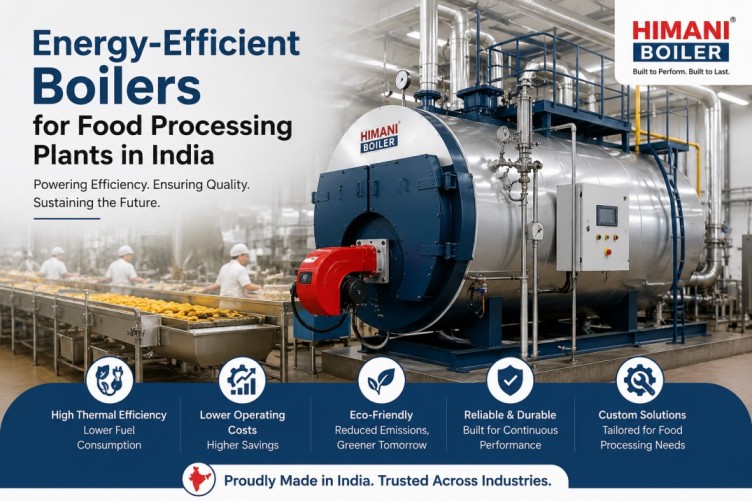
Energy-Efficient Boilers for Food Processing Plants in India
If you run a food processing plant in India, your boiler is probably one of the biggest energy costs you deal with every single day. Steam is needed at almost every stage: blanching, sterilisation, cooking, drying, and cleaning. And, if your boiler is running inefficiently, that cost quietly eats into your margins month after month.
The food processing sector in India is growing fast, and so are the energy bills that come with it. But here's the thing. The right boiler doesn't just cut fuel costs; it also helps you stay compliant with BEE and CPCB norms, which are getting stricter every year.
Whether you're setting up a new plant or replacing old equipment, choosing an energy-efficient boiler is one of the smartest operational decisions you can make. Himani Boiler has been helping food processing units across North India do exactly that.
Why Energy Efficiency Matters More in Food Processing
Food processing plants run boilers for long hours, often 16 to 24 hours a day. Even a small improvement in thermal efficiency adds up to serious savings over a year.
According to the Bureau of Energy Efficiency (BEE), industrial boilers account for roughly 35% of total energy consumption in the food processing sector. Most older boilers operate at thermal efficiencies between 70% and 80%. A modern energy-efficient boiler can push that to 90% or higher.
That gap is money left on the table every single day.
What Makes a Boiler Energy-Efficient?
Not every boiler sold as "efficient" actually delivers. Here are the real factors that matter:
Thermal Efficiency Rating
Look for boilers rated above 85–90% thermal efficiency. BEE's star rating system for industrial boilers is a reliable benchmark. A 4-star or 5-star rated boiler meets strict efficiency criteria set by the government.
Economiser Integration
An economiser recovers waste heat from flue gases and uses it to preheat feedwater. This alone can improve boiler efficiency by 5–10%, according to BEE guidelines.
Automatic Blowdown Control
Manual blowdown wastes both water and heat energy. Automatic blowdown systems maintain TDS levels precisely, reducing heat loss significantly.
Insulation and Heat Loss Control
Surface heat losses from poorly insulated boilers can account for 1–3% efficiency loss. Good insulation on the shell, pipes, and fittings makes a real difference.
Combustion Control Systems
Modern burners with oxygen trim controls maintain the ideal air-to-fuel ratio automatically. This prevents excess air from carrying away heat through the flue, which is one of the most common causes of efficiency loss in older boilers.
Types of Boilers Used in Food Processing Plants
Different food processing applications need different steam pressures and capacities. Here's a quick overview:
Fire Tube Boilers
Widely used in small to medium food processing units. Simple to operate, easy to maintain. This is what makes them suitable for steam pressures up to 18 bar. The best boilers in Delhi and Gurgaon for mid-sized food plants are often fire tube designs built for reliability and low maintenance.
Water Tube Boilers
They're mostly used where higher steam pressures and larger capacities are needed. Large dairy plants, breweries, or integrated food processing facilities. More efficient at scale and faster to respond to load changes.
Thermic Fluid Heaters
Used in food processing applications where direct steam contact is not suitable, such as edible oil processing, for example. Operate at higher temperatures with lower pressures. This reduces risk of contamination.
Fluidised Bed Combustion Boilers
They are the most suitable for plants that want to use alternative fuels like biomass, rice husk, or bagasse instead of coal or furnace oil. FBC boilers can burn fuels with high moisture content and variable calorific values efficiently.
Fuel Options and What Works Best for Food Plants
Fuel choice directly affects both running costs and emission compliance.
Natural Gas
The cleanest and most efficient fuel for boilers. Lower SOx and particulate emissions, easier to control, and well-suited for food processing environments where hygiene is critical. If your plant is in Delhi or Gurgaon and connected to the gas grid, this is worth serious consideration. The best boilers in Gurgaon for food plants are increasingly gas-fired for exactly this reason.
Biomass and Agricultural Waste
Rice husk, mustard stalk, and sugarcane bagasse are widely available across Haryana and UP. Biomass-fired boilers have lower fuel costs and qualify for renewable energy benefits. CPCB norms apply to particulate emissions, so proper pollution control equipment is essential.
Furnace Oil and LDO
Used in older installations. Higher emission levels mean stricter compliance requirements, and fuel costs are more volatile. Many plants are moving away from these fuels.
CPCB and BEE Compliance — What Food Processing Plants Need to Know
Regulatory compliance is not optional, and the standards are getting tighter.
The Central Pollution Control Board has set particulate matter emission limits for industrial boilers. For boilers above 500 kW thermal input, the limit is 150 mg/Nm³ for biomass-fired units and tighter still for coal. Many states have additional requirements on top of national norms.
BEE's Perform Achieve and Trade (PAT) scheme covers large energy-consuming industries, including food processing. Plants covered under PAT are required to meet specific energy consumption targets or purchase energy-saving certificates.
A properly sized, energy-efficient boiler helps you stay inside both sets of requirements without scrambling at audit time.
Common Mistakes Food Processing Plants Make with Boilers
These come up again and again in plants across Delhi-NCR:
- Oversizing the boiler — A boiler running at 40–50% of its rated capacity runs less efficiently than one sized correctly for the actual load. Get a proper load assessment done before specifying capacity.
- Ignoring blowdown heat recovery — Heat in blowdown water is recoverable using a flash vessel and heat exchanger. Most plants skip this and waste energy quietly every day.
- Delaying tube cleaning — Scale buildup of just 1mm on heat transfer surfaces can increase fuel consumption by up to 2%, according to BEE technical guides. Regular descaling pays for itself quickly.
- Running boilers on manual controls — Automatic combustion management, automatic blowdown, and remote monitoring all reduce fuel waste and operator error.
Why Himani Boiler for Your Food Processing Plant
Himani Boiler supplies and services industrial boilers across Delhi, Gurgaon, and the wider NCR region. For food processing clients specifically, the focus is on getting the right combination of capacity, fuel type, and efficiency for your actual production load. Not just selling you a standard unit off a catalogue.
The best boilers in Delhi for food processing plants are ones that are correctly specified, properly installed, and backed by reliable after-sales service. The best boilers in Gurgaon need to meet both Haryana state pollution norms and BEE efficiency benchmarks. And that requires someone who understands both the equipment and the regulatory environment.
Whether you need a new gas-fired fire tube boiler for a dairy unit, a biomass FBC boiler for a grain processing facility, or an upgrade to your existing system. Himani Boiler can assess your requirements and recommend what actually makes sense for your plant.
Final Word
Energy efficiency in boilers is not just a technical specification. It's a daily operating cost decision. For food processing plants in India running boilers round the clock. Even a 5% improvement in thermal efficiency can translate into significant annual savings on fuel bills.
The best boilers in Delhi and the best boilers in Gurgaon are the ones built for your load, your fuel, and your compliance requirements. Not just the ones with the lowest price tag on the invoice.
Get a proper assessment done, specify correctly, and invest in a boiler that pays for itself over time.